Applying To College

College Essay Writing and Interview Skills


1 Comment

How To Write A Great College Application Essay: Infographic

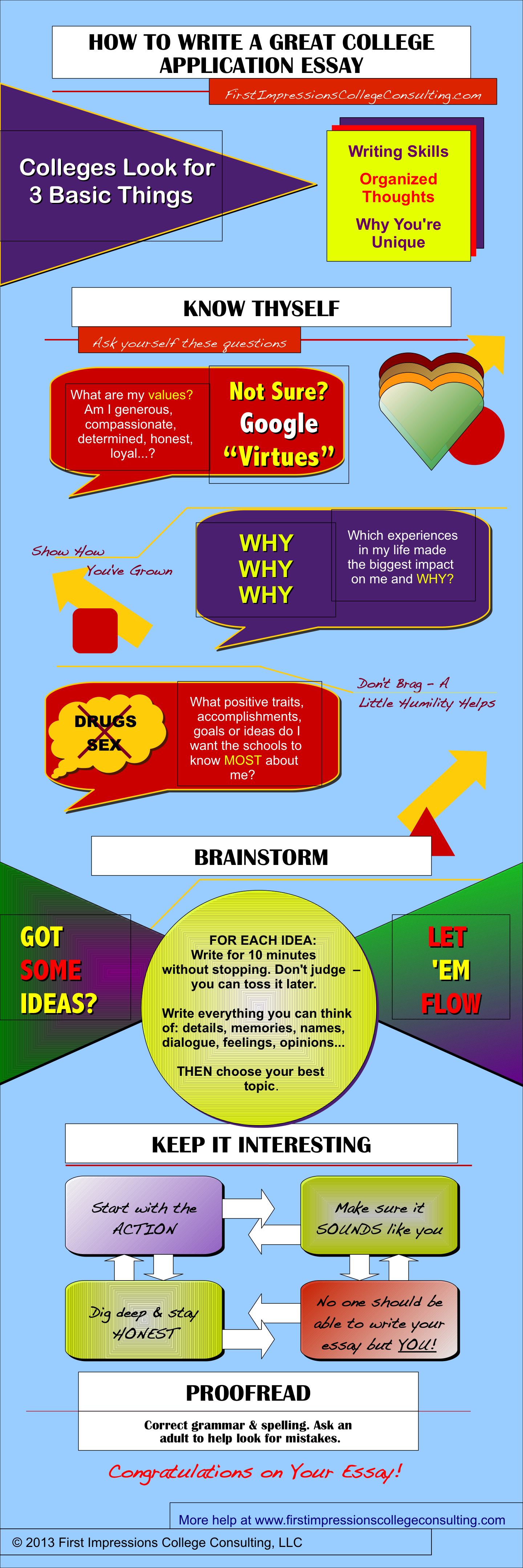
Here it is, my first infographic. I won’t tell you how long it took me, but it was worth it. Enjoy.

How to write a great college application essay infographic

sharon-epstein-college-essay-writing-and-interview-skillsSharon Epstein is owner of First Impressions College Consulting in Redding, Connecticut.
Need help? I work with students everywhere: in-person, over the phone, and by email. Visit my website for more info. Connect with me on Google+, Twitter and Pinterest:

follow Sharon Epstein on Twitterfollow Sharon Epstein on pinterest


7 Comments

Common App 2013 Essay Prompts

Common Application essay prompts 2013

The 2013-2014 Common Application won’t formally launch until August 1, but  the Common Application essay prompts are already out.

There are changes from last year:

650 word limit (up from 500)
All-new prompts
No “topic of your choice”

Here are the 2013 Common Application Essay Prompts with Instructions:

Instructions: The essay demonstrates your ability to write clearly and concisely on a selected topic and
helps you distinguish yourself in your own voice. What do you want the readers of your application to
know about you apart from courses, grades, and test scores? Choose the option that best helps you
answer that question and write an essay of no more than 650 words, using the prompt to inspire and
structure your response. Remember: 650 words is your limit, not your goal. Use the full range if you need it, but don’t feel obligated to do so. (The application won’t accept a response shorter than 250 words.)

  1. Some students have a background or story that is so central to their identity that they believe their application would be incomplete without it. If this sounds like you, then please share your story.
  2. Recount an incident or time when you experienced failure. How did it affect you, and what lessons did you learn?
  3. Reflect on a time when you challenged a belief or idea. What prompted you to act? Would you make the same decision again?
  4. Describe a place or environment where you are perfectly content. What do you do or experience there, and why is it meaningful to you?
  5. Discuss an accomplishment or event, formal or informal, that marked your transition from childhood to adulthood within your culture, community, or family.

In future posts I’ll give you easy-to-follow tips on writing your 2013 College Application essay.

sharon-epstein-college-essay-writing-and-interview-skillsSharon Epstein is owner of First Impressions College Consulting in Redding, Connecticut.
Need help? I work with students everywhere: in-person, over the phone, and by email. Visit my website for more info. Connect with me on Google+, Twitter and Pinterest:

follow Sharon Epstein on Twitterfollow Sharon Epstein on pinterest


Leave a comment

Beginning the College Search – Round 2

College search - College search - second time around

Spencer and Holly Manners at Holly’s graduation from GW last spring

Applying to College welcomes a new series of guest posts by Beth Manners, whose son Spencer is beginning his college search. This is Beth’s second time conducting a college search; her daughter Holly graduated from George Washington University last spring. Follow Beth as she shares her advice and experiences conducting a college search, the second time around.

Pass the baton – or more like pass the Fiske Guide.  My daughter Holly just graduated from George Washington University and it’s time to begin the college search with my son Spencer – a junior in high school.

In truth, the search began when Spencer was eleven and tagged along on all of our college visits.  Who would think that from behind that Game Boy an impression was being made?

My husband and I are planning to take Spencer to visit colleges during February break.  I’ve found that it’s important to visit when school is in session. You want to meet students, peek into actual classes, have a meal in the cafeteria, and get a general feel for the energy and personality of the campus.

Even though Spencer says he prefers a large city school, we are going to experience a variety of schools – so that as a sixteen year old he can take it all in. Our trip will include Boston University, Penn State, Franklin and Marshall, Lehigh, and Lafayette. Many different impressions will be made.

As a parent who’s done this once already, I want to share my experiences on how best to start your college search:

  • Consider a variety of schools. Try to visit a large school, a small school, a city campus and a more remote rural campus. From the initial visits, you can then develop preferences, which will guide you in putting together a broader list of schools to research, visit and consider.
  • Save the airfare for later. Even if you have no geographic restrictions, you may want to limit the initial visits to within a day’s drive of your home. No sense in flying across the country, just to discover that small schools are not what you want.  Save the airfare for later on in the process.
  • Contact the college admissions office in advance and schedule an information session and a college tour.  Down the road, when your application is being read, the college will value “demonstrated interest” as one consideration. Many schools track whether you have visited campus – so be sure they have your name.
  • Keep notes on each school and take some pictures. After many visits, it is easy to confuse schools.  Jot down your initial impressions and also some specifics.  What do you like about the school and what is unique about it?  In addition to helping you decide where to apply, you can use this information to answer application and interview questions.
  • After the campus tour, you may want to dig deeper.  Holly met with the captain of the riding team at Boston University, a marketing professor at UCONN and the study abroad office at GW.  We scheduled these meetings before visiting campus.  Ask the admissions staff how to make arrangements.
  • Ask questions. Is it easy to change majors? Is campus housing guaranteed? Is the admissions process need-blind?  Does student social life center around the campus – or the city? Do they have vegan options in the cafeteria?  Gather as much information as you can and reach out and speak to current students.  Read the college’s newspaper and have a look at bulletin boards, to learn even more.
  • Is the school a keeper? Right now, you’re starting to discover your preferences and map out a direction.  If the school has subjects you want to study, recreational activities you want to be involved in and people you want to meet – and you connected to the campus, put it on the list.  Yes, you should be excited!

And so it begins…

Beth Manners college search
Beth Manners is a Tufts University Alumni interviewer and is currently enrolled in the UCLA College Counseling Certificate program. She lives in Westport, Connecticut.


1 Comment

Free College Essay Writing Program – February 12 Darien Library

Darien Library Believe it or not, it’s time to start thinking about college application essays! That’s why I’m inviting you to join me and Matthew Dempsey, Assistant Director of Admission at Fairfield University, for “The ABC’s of Writing a Great College Application Essay.” You’ll learn how to write unique and memorable college application essays and what schools look for when they read them.
…………….
  • Date: February 12, 2013
  • Time: 7pm
  • Place: Darien Library, Darien, Connecticut
  • Admission: Free
Why this Program WORKS:

It’s from two important points of view. I discuss how to write college application essays, and Matthew tells you what colleges look for when they read those essays.

What You’ll Learn:

I’ll give you an overview of the college essay writing process, including what schools look for, good and bad topic choice, and how to make every essay unique. Matthew will discuss what kind of essays work and don’t work, and how essays are viewed in the context of the entire application.

Who Should Come:

High school students and their families. Freshman and sophomores are welcome, too. It’s never too early to begin to understand what this application business is all about!

Isn’t February Early?

No. For the first time, college essay prompts will be published in March. Get a head start with this program.

Put February 12 on your calendar and learn about writing a great college application essay. See you at the Darien Library!

sharon-epstein-college-essay-writing-and-interview-skillsSharon Epstein is owner of First Impressions College Consulting.
Need help? I work with students everywhere: in-person, over the phone, and by email. Visit my website for more info. Connect with me on Google+, Twitter and Pinterest:

follow Sharon Epstein on Twitterfollow Sharon Epstein on pinterest


Leave a comment

Writing College Essays: Skills for the Real World – One Student’s Story

-essay-writing-job-internships

Applying to College welcomes a guest post from Yue Ren, a freshman at Harvard College. Yue currently works at Argopoint LLC, a Boston-based management consulting firm.

Editor’s Note: When Yue wrote to me he said, “As a regular follower of your blog, I just wanted to reach out to tell you what an excellent job you have been doing…I believe your blog helped me immensely in being accepted at Harvard where I am a current freshman. However, it is only recently that I realized that your advice extends far beyond the scope of just the college applications process. Your nuggets of wisdom actually helped me develop a good ethic for applying to courses, clubs, and jobs...I believe that prospective students would gain much from understanding the value of your advice beyond the scope of just college applications because these skills are absolutely essential in the real world.”

This is Yue’s post:

I have found Sharon’s advice on Applying to College to be insightful in helping prospective college students write great essays. Not only have I found her advice integral to writing great college application essays, but also applications in general for jobs, internships, and more. First, I would like to provide my thoughts on college essays to highlight the importance of these elements in the real world.

When admission officers flip through your application, they see your transcript, GPA, SAT or ACT scores, the quick descriptions of your extracurricular activities, perhaps a few AP scores and even a couple of awards, but all that seems very quantitative. What part of the application defines you? After writing quite literally over a dozen college essays and supplemental essays, I believe I have garnered a couple of observations. Although I do not have all the answers, I believe these tips would have been helpful when I was writing my first college essay as well as subsequent essays for jobs:

  •  Express Yourself with a Story: In my experience, the best way to communicate an idea is to tell a quick, concise anecdote. Think about all those lessons you have learned in your extracurricular activities or throughout your life. What do these stories tell about your talents, aspirations, or character? I also believe the manner in which you tell a story, including your tone, mood, and attitude, reflects on how you react to certain challenges or successes. This provides just as much information to the reader about your character as the actual story you write. Therefore, word choice in your expression is crucial.
  • Be Human: Why is talking to your friend so much more fun than reading an old biography? Construct your stories with feelings and emotions such that the reader can experience the breadth and depth of your happiness, anger, pain, or excitement. If you are ever wondering why your friend refuses to give any hints about his or her essay, it might be because it is personal; it might reflect intense emotions. A journey in a day in the life of you is filled with crescendos and decrescendos that may ultimately shape your outlooks. Do not be afraid to share them with admissions.
  • Write Truthfully: Honestly, lying is hard. No matter how much detail you slap on a lie, there are crucial, significant elements that are still missing. Not only do these missing elements signal a lie, but also they are the parts of the story that provide genuineness and insight into your life. Save yourself the trouble of trying to write about stuff that you have never done, and just pour your heart and mind into those events you have faced. If you participated in a thousand extracurricular activities in high school, now is a perfect chance to talk about a few of those thousand topics.
  • Seek Peer Critique: Although many people choose to not let anyone see their essay, I found that letting your teachers and maybe a close friend see your essay brings new perspective.

Going back to how word choice is crucial: Some words simply rub people the wrong way, and it is probably best not to rub admissions the wrong way. Here is an example:

Original: “Students from Estonia to Chile took the course; we were in this together from all around the world.”
Edit: “From Estonia to Chile, our interdependence garnered an engaging international learning experience.”

In the first example, there is a sense of camaraderie and hints to a sense of mutual benefit from engaging with students all over the world. However, to my teacher, it also sounded rather suspicious and implied that students were in it together to defend against something. In addition, admission officers are only taking so much time to read your essays. Make your expression clear. The edit uses more sophisticated, mature language, which demonstrates a fluency with words. The advantage of the edit is the clear message that learning together with diverse students derived mutual benefit.

You cannot control what your reader thinks or how your reader interprets your essay; you can control how you express your ideas. Therefore, express them wisely and always be conscious of your audience.

To keep the college essay in context, it is just one part of your application, but I would recommend treating it as the part of the application that truly identifies you. It is an opportunity, not another barrier keeping you from clicking that submit button.

Beyond the College Essay: Writing for Jobs, Courses, and Internships

Sharon’s blog is truly awesome. I would check some of the posts like “Stuck? 5 Tips to Jump-Start Your College Essay,” “How to Succeed with the Common App Essay Word Limit” series, for advice on college essays. I know I found them abundantly helpful when I was writing my essays. But her advice extends beyond just the scope of college essays. I would like to stress that for courses, jobs, or internships, I found these tips equally as applicable and useful as they are for college essays.

  • When I wrote my cover letter for my internship at Argopoint, I specifically used examples of past experiences and extracurricular activities in form of anecdote compressed in a sentence or two to highlight my skills and abilities. I also sought help from peers who have experience with applying to jobs, and who helped critique my cover letter. Of course being frank and honest is important. Here is an example of a question I had to answer:
  • Question: “Why do you want this position?”

This question is an almost guaranteed question at any place of employment. I responded along the lines of: “Although I am only a freshman at college, I have great vision of what I want to do. (Give a quick idea of what you want to do). To be frank, I may not be fluent in everything provided in the job description, but I am an eager, fast-learner. I once (I would have specified the exact activity here) led a body of over 100 students with no prior leadership experience to great success. I found that the keys to my success were consistency, encouragement, and commitment. I am confident that this combination will allow me to make a contribution to your organization.”

Because I gave a quick example of an activity I led, I clearly communicated to the listener that: This kid wants to learn and can be honest on areas where he needs improvement. He clearly faced a respectable challenge and emerged successful. Even though that may not align perfectly with the work done at the organization, this is the attitude required to succeed. Finally, this freshman seems ready to contribute.

Going through the college applications process, you will discover that the tips garnered from the Applying to College blog and lessons learned from writing great college essays will be crucial in scoring opportunities in your future.

-Yue


Leave a comment

3 FAFSA Myths Debunked – Why You Might Not Apply, But You Should

filling out FAFSA

Are you planning on submitting a FAFSA (Free Application for Federal Student Aid)? It turns out some students just don’t bother to apply. Knuckleheads.

I just wrote a newsletter on why submitting a FAFSA early can get you more loan money. (You can subscribe to my newsletter in the right hand column.)

Here are three of the biggest reasons students don’t bother to apply:

My parents make too much money.

In fact, there is no income cut-off to qualify for federal student financial aid.

My grades aren’t good enough.

The truth is, most federal student aid programs don’t take grades into consideration.

The form is too hard to fill out.

Fill out a FAFSA online and the form will walk you it through step-by-step and you’ll only fill out questions that apply to you. Plus, if you need more help, you can access private, real-time online chat with a customer service rep.

Another good reason to submit a FAFSA? Schools and states use this form. In fact, some schools won’t consider you for financial aid unless you submit a FAFSA.

So go ahead. Apply.

Help from FAFSA’s website:

Find out your state’s deadline
This video shows you how to fill out the FAFSA
Did you already submit your FAFSA? Here’s what to expect next

related links:
Fox Business News: Four Ways To Prepare for the FAFSA

sharon-epstein-college-essay-writing-and-interview-skillsSharon Epstein is owner of First Impressions College Consulting.
Need help? I work with students everywhere: in-person, over the phone, and by email. Visit my website for more info. Connect with me on Google+, Twitter and Pinterest:

follow Sharon Epstein on Twitterfollow Sharon Epstein on pinterest
Leave a comment — let me know what you think!


2 Comments

5 Questions to Ask Students on Your College Visit

Ask questions on college visits. Don’t just talk to adults — ask the students who go there.

Why?

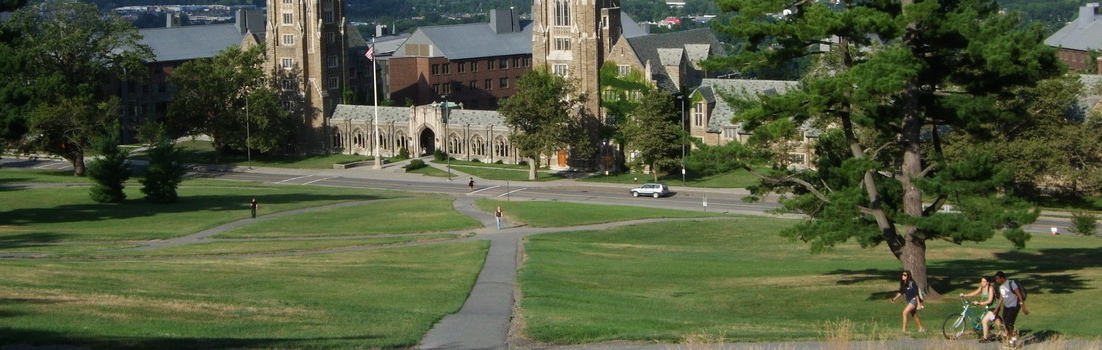
Campus Tour at Cornell

Campus Tour at Cornell

1. You’re going to choose where you’ll spend the next four years of your life. It’s an important decision. Don’t choose a college because you “think you should go there” – choose it because you see yourself living – and thriving – there.

2. Many colleges require a “Why Do You Want to Go To Our School” essay when you apply. This is an important essay – one that could even determine if you get in. Ask good questions on your visit and you’ll be able to write an impressive answer when you apply.

USA TODAY College just published 5 Questions to Ask Current Students on Your College Visit. Check it out. The questions include asking about the best professors, what you can do in town, who to get to know, and what things to avoid. I’m sure you can think of a few of your own.

When you visit, find current students and ask questions. If you can see yourself becoming one of those students, it might just be the school for you.

related links:
“Why This College”: What Schools Want
5 Steps to a Great “Why This College” Essay

Part 3: “Why This College?” Essay Examples

sharon-epstein-college-essay-writing-and-interview-skillsSharon Epstein is owner of First Impressions College Consulting.
Need help? I work with students everywhere: in-person, over the phone, and by email. Visit my website for more info. Connect with me on Google+, Twitter and Pinterest:

follow Sharon Epstein on Twitterfollow Sharon Epstein on pinterest
Leave a comment — let me know what you think!


Leave a comment

2013 Spring College Fair Schedule

Looking for a College Fair in your area?

Here’s the list of  Spring 2013 college fairs sponsored by National Association for College Admission Counseling.  For more info, click on the name or go to National College Fairs.

FEBRUARY 6 & 7
David L. Lawrence Convention Center
Pittsburgh, PA
Wednesday, February 6: 9:00 a.m. – 12:00 p.m., 6:00 p.m. – 8:30 p.m.
Thursday, February 7: 9:00am – 12:00pm
FEBRUARY 10
Atlanta National College Fair
Georgia World Congress Center
Atlanta, GA
12:00 p.m. – 4:00 p.m.
FEBRUARY 24
Miami National College Fair
DoubleTree by Hilton Miami Airport Convention Center
Miami, FL
12:00 p.m. – 4:00 p.m.

MARCH 3
Louisville National College Fair
Kentucky International Convention Center
Louisville, KY
2:00 p.m. – 5:00 p.m.
March 3
Tampa National College Fair
Tampa Convention Center
Tampa, FL
12:00 p.m. – 3:00 p.m.
MARCH 10 & 11
Syracuse National College Fair
SRC Arena
Onondago Community College
Syracuse, NY
Sunday, March 10: 1:00 p.m. – 4:00 p.m.
Monday, March 11: 9:00 a.m. – 12:00 p.m.

MARCH 13
Rochester Riverside Convention Center
Rochester, NY
9:00 a.m. – 12:00 p.m., 6:00 p.m. – 8:30 p.m.
MARCH 17
The Park Expo and Conference Center
Charlotte, NC
12:00 p.m. – 4:00 p.m.
MARCH 19
Raleigh Convention Center
Raleigh, NC
4:00 p.m. – 8:00 p.m.
MARCH 26 & 27
Buffalo Niagara Convention Center
Buffalo, NY
Tuesday, March 26: 9:00 a.m. – 12:00 p.m., 6:00 p.m. – 8:30 p.m.
Wednesday, March 27: 9:00 a.m. – 12:00 p.m.
APRIL 7 & 8
Eastern States Exposition (The Big E)
West Springfield, MA
Sunday, April 7: 1:00 p.m. – 4:00 p.m.
Monday, April 8: 9:00 a.m. – 11:30 a.m.
April 8
Dallas/Ft. Worth National College Fair
Irving Convention Center at Las Colinas
Irving, Texas
4:00 p.m. – 8:00 p.m.
April 9
Austin National College Fair
Austin Convention Center
Austin, TX
5:30 p.m. – 8:30 p.m.

Grand Rapids, MI
8:30 a.m. – 11:30 a.m., 6:00 p.m.–8:00 p.m.
April 11
Metro Detroit National College Fair
Cobo Center
Detroit, MI
8:30 a.m. – 12:00 p.m., 6:00 p.m. – 8:00 p.m.

—-
April 11
Houston, TX
12:30 p.m. – 2:30 p.m., 6:00 p.m. – 8:00 p.m.
April 11 & 12
Hartford National College Fair
Connecticut Convention Center
Hartford, CT
Thursday, April 11: 9:00 a.m. – 11:30 a.m., 6:30 p.m. – 8:30 p.m.
Friday, April 12: 9:00 a.m. – 11:30 a.m.

April 17 & 18
Montgomery County National College Fair

Montgomery County Agricultural Center
Gaithersburg, MD
Wednesday, April 17: 9:45 a.m. – 12:45 p.m., 6:30 p.m. – 8:30 p.m.
Thursday, April 18: 9:45 a.m. – 12:30 p.m.
April 19
Prince George’s County National College Fair

Prince George’s Sports and Learning Complex
Landover, Maryland
9:30 a.m. – 3:30 p.m.
Concourse Exhibition Center
San Francisco, CA
1:30 p.m.–4:30 p.m.
April 21
Cleveland National College Fair

Wolstein Center
Cleveland, OH
1:00 p.m. – 4:00 p.m.
April 22
Honolulu National College Fair

Hawaii Convention Center
Honolulu, HI
8:30 a.m. – 11:30 a.m., 5:00 p.m. – 8:00 p.m.
April 23
Ventura/Tri-County National College Fair

Ventura County Fairgrounds
Ventura, CA
5:30 p.m.–8:30 p.m
April 23 & 24
Greater Memphis National College Fair

Agricenter International
Memphis, TN
Tuesday, April 23: 6:00 p.m. – 8:00 p.m.
Wednesday, April 24: 9:00 a.m. – 12:00 p.m.
April 24 & 25
New Jersey National College Fair

Meadowlands Exposition Center (at Harmon Meadow)
Secaucus, NJ
Wednesday, April 24: 9:00 a.m. – 12:00 p.m., 6:00 p.m. – 9:00 p.m.
Thursday, April 25: 9:00 a.m. – 12:00 p.m.
April 25
Greater Los Angeles National College Fair
Pasadena Convention Center
Pasadena, CA
9:00 a.m. – 12:00 p.m., 6:00 p.m. – 9:00 p.m.

April 25
Nashville National College Fair

Belmont University
Nashville, TN
5:00 p.m. – 8:00 p.m.
April 27
Providence National College Fair

Rhode Island Convention Center
Providence, RI
12:00 p.m. – 3:00 p.m.
Jacob K. Javits Convention Center of New York

New York, NY
11:00 a.m. – 4:00 p.m.

April 28
Anaheim Convention Center
Anaheim, CA
1:30 p.m. – 4:30 p.m.
April 30
San Diego National College Fair
San Diego Convention Center
San Diego, CA
9:00 a.m. – 12:00 p.m., 6:00 p.m. – 8:30 p.m.
Boston Convention & Exhibition Center (BCEC)

Boston, MA
Tuesday, April 30: 9:00 a.m. – 12:00 p.m., 6:00 p.m. – 8:30 p.m.
Wednesday, May 1: 9:00 a.m. – 12:00 p.m.
May 2
Ontario Convention Center
Ontario, CA
9:00 a.m.–12:00 p.m., 6:00 p.m.–8:00 p.m.

sharon-epstein-college-essay-writing-and-interview-skillsSharon Epstein is owner of First Impressions College Consulting.
Need help? I work with students everywhere: in-person, over the phone, and by email. Visit my website for more info. Connect with me on Google+, Twitter and Pinterest:

follow Sharon Epstein on Twitterfollow Sharon Epstein on pinterest
Leave a comment — let me know what you think!


Leave a comment

Disastrous email snafus and how to avoid them

How To Handle Email Snafus

How To Avoid Embarrassing Email Snafus

We’ve all made email mistakes (typos, wrong names, hitting “reply all” when you don’t want everyone to see your personal business), but some are worse, and far more embarrassing than others.

If you’re applying to college you need to make a good impression. Here’s a great article from USA TODAY on how to avoid email mistakes:

Disastrous email snafus and how to avoid them | USA TODAY College.


sharon-epstein-college-essay-writing-and-interview-skillsSharon Epstein is owner of First Impressions College Consulting
Need help? I work with students everywhere: in-person, over the phone, and by computer. Visit my website for more info. Connect with me on Google+, Twitter and Pinterest:

follow Sharon Epstein on Twitterfollow Sharon Epstein on pinterest
Leave a comment — let me know what you think!


Leave a comment

Writing College Essays: 3 Words to Ditch

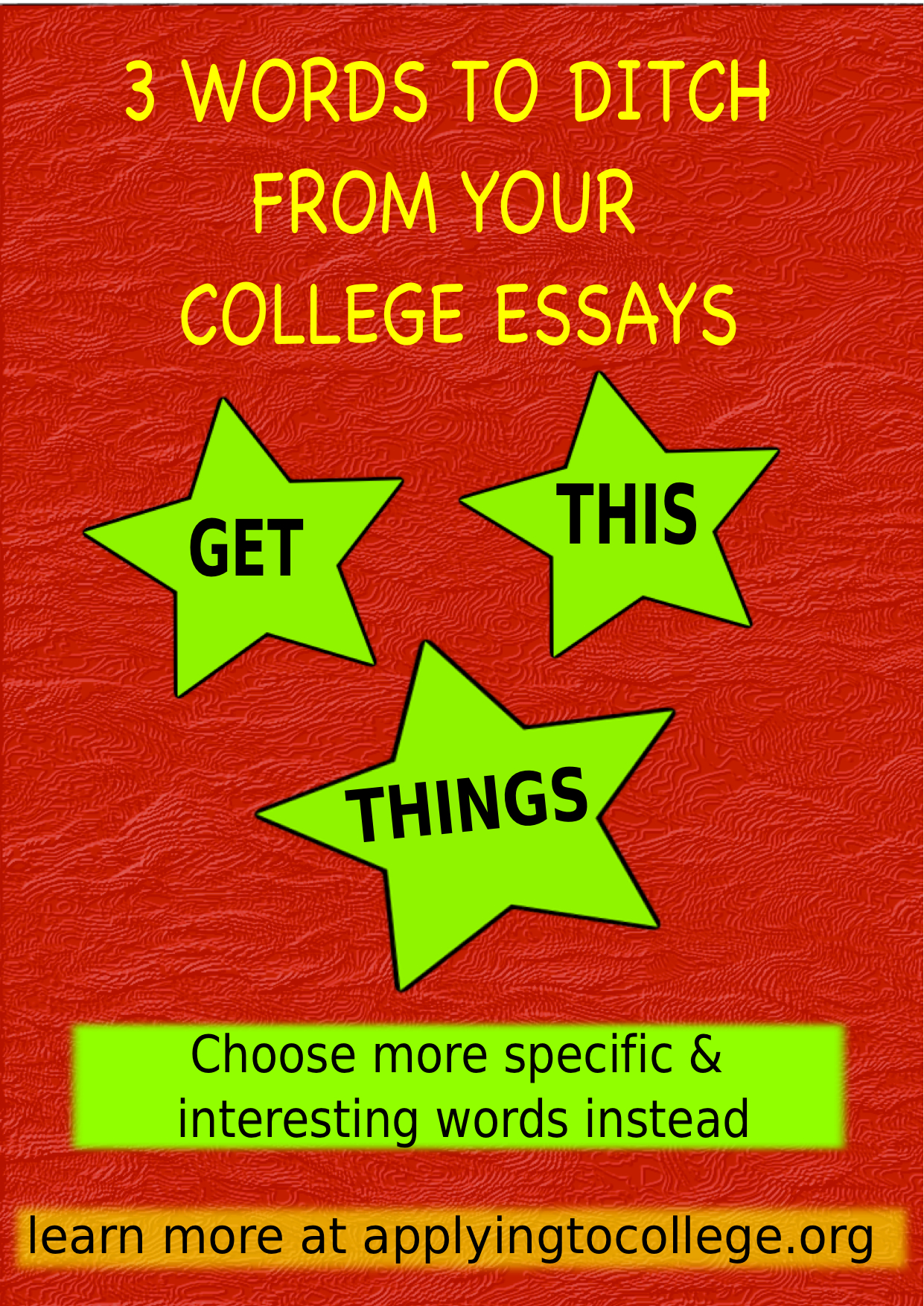
college essay writing: 3 weak wordsSome words shouldn’t find their way into college application essays. I’m not talking about words that make you sound like a thesaurus (I’ll get to that at a later date) – I’m talking about words that are weak.

Weak words are like limp handshakes – a little damp, a little icky – you wish the person shaking your hand had the confidence to do it right. Maybe nobody told them. Which is why I’m telling you.

3 of the Weakest Words in College Essays:

1. Things
2. Get
3. This

What Makes These Words Weak?
They’re all vague. (What “things” are you talking about, anyway?) They’re also BORING.
Please, don’t bore your college reader (zzzzzzzz).

How Do You Get Rid of Weak Words?
Easy. Learn to recognize them, and then substitute stronger, more interesting words. Interesting words are often more specific words.

Here are examples of how to change weak words to strong:

1. Things

Weak: “I enjoy learning about certain things on my own.”
Strong: “I enjoy learning about science and math on my own.”
Weak: “I frequently hear things like, “Hey Smart Girl, I bet you know everything.”
Strong: “I frequently hear comments like, “Hey Smart Girl, I bet you know everything.”

2. Get

Weak: “The day after getting the ping-pong table, I asked my dad to play with me.”
Strong: “The day after the store delivered the ping-pong table, I asked my dad to play with me.”
Weak: “If snow was predicted, I’d head out in the middle of a storm to get the driveway cleared.”
Strong:If snow was predicted, I’d head out in the middle of a storm to clear the driveway.”

3. This

Weak: “I’ve been working on this since last summer.”
Strong: “I’ve been working on my carpentry skills since last summer.”
Weak: “I didn’t pursue this expecting to become a professional.”
Strong: “I didn’t pursue dance expecting to become a professional.”

Find the weak words in your essays and substitute stronger ones. You’ll show off your writing skills, and impress your college reader.

sharon-epstein-college-essay-writing-and-interview-skillsSharon Epstein is owner of First Impressions College Consulting
Need help? I work with students everywhere: in-person, over the phone, and by computer. Visit my website for more info. Connect with me on Google+, Twitter and Pinterest:

follow Sharon Epstein on Twitterfollow Sharon Epstein on pinterest
Leave a comment — let me know what you think!