I was delighted to write this article for this week’s Redding Sentinel to help teens ace their job interviews.
Are you a teen who has a job or internship interview coming up? Do you know someone who does? For students without much – or any – interview experience, the prospect can be daunting.
The good news is that by learning basic interview techniques, teens can increase their confidence levels and make a positive impression in interviews. I’ve taught these skills to my students, and I always enjoy seeing their confidence grow. For this article, I also spoke with Redding’s Park and Recreation Director, Rob Blick, to get his insight about what he looks for when interviewing students for summer jobs.
Here are 9 Job Interview Tips for Teens
1. Know Your Strengths
The better you know yourself, the more comfortable you’ll be talking about yourself in an interview. Start by making a list of your positive qualities. (Are you determined, friendly, a leader?)
Next, list your accomplishments, awards, interests, and hobbies. Ask your parents and friends too; they can provide a perspective you might not have thought of.
“It’s good to be proud of your accomplishments, even if they’re small,” says Blick. He adds that there might be accomplishments you haven’t considered. “If you’re busy and do a lot, that’s an accomplishment,” he says.
Takeaway:Know your skills and strengths because they’ll become the foundation of your interview.
2. Find Examples to Talk About
Come up with four or five examples that illustrate the positive qualities or experiences you’d like to highlight. Strong examples include leadership, ability to work as a team member, a meaningful activity, and a time you overcame an obstacle.
It’s common to feel like it’s bragging to say “I did this” or “I helped my team” do that, but practice will help you become more comfortable talking about yourself.
Takeaway:Find your best examples and practice telling them. Now you’ve got lots to talk about in your interview!
3. Do Your Research
Go to the company’s website and jot down the key points that make you feel you’d be a good fit and excited to work there. Interviewers like applicants who are prepared and enthusiastic.
Takeaway:When interviewers see you’ve done your research, they’ll know you’re seriously interested.
4. Practice Answering Common Questions
Practicing is the best thing you can do to prepare. You should know how to answer these and other common interview questions: Why do you want to work here? Tell me about a couple of your strengths. What’s a weakness you have? What are your favorite subjects in school and why? How would your friends or teachers describe you? What are you proud of? Tell me about a time you faced an obstacle or challenge.
“There will be questions about you and your life,” says Blick. Think about what you’re proud of — maybe it’s a choice or a difficult decision.” Blick adds that he’ll often ask, “Why is your best friend friends with you?” because he likes to hear that perspective. You can find more common questions online.
Takeaway: Practice beforehand with friends, parents, stuffed animals, even your mirror. You’ll be amazed at the progress you make.
5. Prepare for Interview Day
When interview day arrives, dress appropriately (nothing too revealing, ripped, or wrinkled), arrive at least five to ten minutes early, and shut off your cell phone. Remember to be personable, friendly, and enthusiastic about wanting the job. And relax; it’s normal to be nervous. Take a deep breath and remember you’re prepared.
Takeaway: Nerves are okay on interview day — give yourself a pep talk and remember you’ve prepared.
6. Know How to Start and End An Interview
Greet your interviewer warmly and with a smile. (“Hello, Mr. Jacobs, it’s nice to meet you. Thank you for taking the time to meet with me.”)
At the end, thank the interviewer and make sure to say you enjoyed the experience. (“Thanks for taking the time to meet with me, Mr. Jacobs. I really enjoyed talking with you.”) Saying you enjoyed the experience is important; it helps leave the interviewer with a positive impression.
Takeaway: Remember to be friendly and smile, and let the interviewer know that you appreciate the time.
7. Use Good Body Language
Show the interviewer you’re interested with good body language: sit up straight; look the interviewer in the eye; don’t fidget, twirl your hair, or yawn. Have good energy.
“Good body language helps indicate you want the job,” says Blick.
Takeaway:Good body language is essential — make it work for you.
8. Ask Questions
Create several questions you can ask that aren’t easily answered by the website. It’s okay to write them down and bring them with you.
Blick says, “Ask questions about the position, your role, the work that you’ll do. The questions should indicate you know something about the organization.” He adds, “Ask about the money later in the interview process.”
Takeaway:Asking thoughtful questions shows you’re interested in the job. Don’t start by asking about money.
9. Send a Thank You Note
Email a thank you note right away. The tone should be positive and appreciative but not too casual. Make sure to correctly spell your interviewer’s name and title, and double-check if you’re not sure.
Takeaway:Send a thank you note right away.
Some Final Tips:
Blick says he likes to see teens do the calling about the job themselves rather than having their parents call for them. “We prefer to deal with the person who’s going to be our employee,” Blick says. He adds, “A follow-up phone call by the student after a couple of weeks is appropriate.”
If you know your strengths, do your research, use positive body language, and have examples to tell, you’re on your way to feeling comfortable and confident and having a successful interview.
Sharon Epstein
Sharon Epstein is a Writers Guild Award-winner and two-time Emmy Award nominee, teaching students around the world how to master interview skills, write resumes, and transform their goals, dreams, and experiences into memorable college application essays. She works with students around the world. Visit my website for more info.
I often hear students express this concern about their Common Application essays. They’re worried their experiences aren’t “big” or eventful enough to stand out.
You don’t need a big event in your life to write a standout Common Application essay. In fact, some of the best stories might seem ordinary, but when you look deeper, they’re interesting and original and can express a great deal about the author too.
For inspiration, I’ll tell you about a student who played catch with his little brother every afternoon. His dad came home late in the evening, so instead of heading off to do homework or hang out with friends, the student became his brother’s coach and cheering squad. Those afternoons weren’t “big” events, but writing about them showed how much he valued family and stepped up to lead even when no one asked him to. Writing about those afternoons showcased his positive qualities and helped the schools envision the caring young man and leader he’d be when he got to campus.
Unearthing these smaller moments can be difficult; they don’t always pop into our heads. That’s when more brainstorming is in order.
First, when you’re writing a Common Application essay, it’s important to know what schools are looking for. Colleges want to learn about you: What are some of your best qualities? What experiences have you learned from? What matters to you and why? When schools read your essay, they should get a sense of your strengths and personality and begin to envision how you’ll be a great fit for their school.
To start brainstorming, make a list of your positive qualities. Then write down how you use each quality to react to or handle a situation. For example, “If I don’t know an answer, I’m determined enough to find it. I speak up when I see an injustice.” You might find an interesting topic this way. Another method is to pay attention as you go through your day: What kind of conversations do you engage in with friends and family? How do you pursue your curiosity outside of class? Scroll through photos to spark memories and look around your room for keepsakes or gifts; one might lead to a story to write about.
No matter what topic you choose, it’s important to include what you learned or how you changed from your experience. Whether it’s a new perspective, a better understanding of yourself, or something else, reflection shows the insight you’ve gained. It makes the essay deeper, more thoughtful, and original to you.
So, if you’ve got a “big” experience, great! But writing about how you taught yourself to fish, the dinners you make for friends, or why you love Scrabble matters too. You’ll give the reader a picture of you: what you care about, how you think, and who you are. And ultimately, that’s what schools want to know.
This article first appeared in the Redding Sentinel
Sharon Epstein is a college essay specialist and interview coach. She is a Writers Guild Award-winner and two-time Emmy Award nominee, teaching students around the world how to master interview skills, write resumes, and transform their goals, dreams, and experiences into memorable college application essays. Visit my website for more information about my services.
This year’s Common App essay prompts are the same as last year’s. Here are the Common App essay prompts for 2023-24:
Some students have a background, identity, interest, or talent that is so meaningful they believe their application would be incomplete without it. If this sounds like you, then please share your story.
The lessons we take from obstacles we encounter can be fundamental to later success. Recount a time when you faced a challenge, setback, or failure. How did it affect you, and what did you learn from the experience?
Reflect on a time when you questioned or challenged a belief or idea. What prompted your thinking? What was the outcome?
Reflect on something that someone has done for you that has made you happy or thankful in a surprising way. How has this gratitude affected or motivated you?
Discuss an accomplishment, event, or realization that sparked a period of personal growth and a new understanding of yourself or others.
Describe a topic, idea, or concept you find so engaging that it makes you lose all track of time. Why does it captivate you? What or who do you turn to when you want to learn more?
Share an essay on any topic of your choice. It can be one you’ve already written, one that responds to a different prompt, or one of your own design.
The Common App says that it will also keep the optional COVID-19 question within the Additional Information section.
For over 15 years, I’ve been teaching students how to write standout college application essays. My students have been admitted to colleges from the University of Michigan to Yale to UTAustin to UCLA.
The Common Application essay (also known as Common App) is all about finding your best story, writing it well, and using it to show colleges who you are and what matters to you. That’s the basis of a memorable essay and taking direct aim at your dream school.
So I thought I’d share some of my best tips and answer questions about the Common Application essay and Common App essay prompts for 2020.
In this post I’ll answer these questions:
What’s the Common Application Essay?
What are the Common App Essay prompts for 2020?
What is the Common App essay word limit for 2020?
What are colleges looking for in a Common App essay?
What is the point of the Common App essay?
How important is the Common App essay?
Is one Common App prompt better to answer than another?
“Dear Student, Why do you want to attend our school?”
If it’s because the school is “amazing” or the weather is “awesome,” that’s great — but it’s not going to get your essay noticed. This post will show you how to help your “Why This School” essay stand out.
Here are 5 Tips to Writing a Successful “Why This School” essay:
1. It’s All About Fit: Schools want to know that you “get them”— that you understand why they’re special and how they’re a good fit for you. Think about why the two of you are a good match: Are you attracted to the school’s academic philosophy, courses, traditions, activities, or student life? Take a deep dive into the school’s website, visit if you can, watch videos, and connect on social media. Discover what interests you and write about it. Using details and examples, tell them why their school matters to you.
2. If You’ve Talked to People, Say So. Making personal connections shows initiative and enthusiasm. Whether it’s your tour guide, students you met on campus, an admissions counselor, alum, coach or professor, mention the people you talked to and what you learned from your conversations. Get excited and talk about it!
3. Don’t Use Vague Answers. Anyone can write, “Your school inspires me…the campus is amazing.” But the answers that stand out are going to be specific about why that matters to you. Consider the difference between this sentence: “I like that your campus is in a big city” and this one: “The school blends a big city location with the personal feel of a smaller school that I’m looking for.” Which one stands out to you?
Tip:Visualize yourself as a freshman on campus – it’s a great way to be specific: What classes are you taking? Why do you love being there? How are you contributing to the campus community? Write about it.
4. Don’t Be A Lightweight. It’s okay to mention social environment and dorm life, but they shouldn’t be your primary focus. Focus mainly on academics.
5.Don’t Tell Schools What They Already Know. What if you wrote: “I’m looking forward to going to OUR GREAT SCHOOL U because it has a Division I Soccer Team.”
Good right? No. This is a factual statement. They know they have a Division I soccer team. Personalize it instead: “I’ve been following Division I soccer for years and was excited when OUR GREAT SCHOOL U made it to the NCAA Soccer finals last December. I’ll be in the stands cheering when I get to campus next fall.”
Here’s another example. Instead of this: “Your school offers 325 majors.”
Say why it matters: “Your school’s wide of variety of courses and majors will give me the opportunity to follow my curiosity and explore new ideas and interests as I discover the path to my career.”
Remember — factual statements shouldn’t stand on their own. Stop and tell them why it matters to you.
Discover what excites you and then show how you’ll contribute and fit in. You’ll be on your way to a great “Why This School” essay.
For more “Why This School” help, read my extended series:
Sharon Epstein is a Writers Guild Award-winner and two-time Emmy Award nominee, teaching students around the world how to master interview skills, write resumes, and transform their goals, dreams and experiences into creative and memorable college application essays. I work with students everywhere: in-person, by phone, FaceTime, Skype and email. Visit mywebsite for more info. Connect onPinterestandTwitter.
Welcome! This article gives you helpful tips for writing the 2019-2020 Common Application essay prompts 4-7, so you can create a strong, compelling and memorable essay.
In this post, you’ll learn what schools look for in Common Application essays, how to choose a prompt, Common App do’s and don’ts, and how to avoid college essay pitfalls. We’ll look at each prompt, and you’ll get to see Common App essay examples too.
Ready? Let’s do it!
How to Write Common Application Essay Prompt #4: A Problem You’ve Solved or Would Like to Solve.
Here’s the prompt:
Describe a problem you’ve solved or a problem you’d like to solve. It can be an intellectual challenge, a research query, an ethical dilemma—anything that is of personal importance, no matter the scale. Explain its significance to you and what steps you took or could be taken to identify a solution.
Is this Prompt for You? Look at the Keywords:
“Problem you’ve solved or would like to solve”…“Personal importance”…“No matter the scale”…”Steps you took or could be taken”
Do the Keywords Apply to You?
Answer yes IF:
1. You’ve identified a problem with meaning and importance to you. 2. You’ve actively worked on a solution OR can discuss the steps needed to get there.
Why Should You Consider This Topic?
1. You get to write about a meaningful idea or experience. 2. You can show off your problem solving skills. 3. You can show off your critical thinking skills. 4. Colleges see how you’re able to plan a course of action in order to achieve a goal.
Pitfalls to Avoid:
This Question Has Four Parts: Describe a problem, explain its significance to you, identify a solution, and describe how you achieved it or might begin to achieve it. Make sure you answer all four parts. Don’t be Generic. Let’s say you want to write about world peace. Do you have something specific to say, or will you be writing empty phrases like “everyone should get along” and “peace will help save the world”? Choose a topic with a personal connection and drill down with specifics. Don’t Skimp on the Solution. Set up the problem and then devote most of your essay to the solution. That’s how you’ll show off your critical thinking skills. It’s Not Always a Solo Act. Your solution may require a team or teams of people with specific skills to achieve your goal. That’s okay. Write about who they are (scientists, politicians, researchers..?) and what they’ll contribute. Part of your problem-solving process is to figure out what support you’ll need.
Not Sure This Question Relates to You? Here Are Questions You Can Ask Yourself:
— Am I a budding scientist with research ideas? — Do I have an idea for a product that solves a problem? — Have I figured out a way to make everyday life a little easier? — Was I ever creative or resourceful when it came to solving a common problem? — Have I been involved with a group, program, or internship where I learned about a problem that became important to me, and now I’ve got ideas about how I can continue to think about or work on it?
Examples of Successful Common App Essay Topics
“Brain Farts”
Jeremy was driving home and missed the turn down his street. He was stumped. He couldn’t figure out why he’d missed something he had done a hundred times. He wanted to know what caused his “brain fart,” so he found the scientific name (maladaptive change) and developed a two-part experiment to identify and predict when these changes would occur.
In his essay, Jeremy lays out the two part experiment he devised to predict these brain changes. He hopes to get the chance to conduct his experiment when he gets to college. In this essay, Jeremy was able to demonstrate his scientific mind and his problem-solving skills.
“Water Pollution Detective”
During a school research project, Liz helped identify the source of pollution flowing into a local river. Helping her town meant a lot to her, and now she wants to do more. Liz plans to contact local authorities and work with them to set up a better monitoring system to prevent future spills. She hasn’t implemented the solution yet, but Liz can explain the steps she’d take to get there.
“Saving the Crops”
Lily, a student from China, witnessed locusts destroy her entire community’s harvest. Lily reasoned that if scientists could understand more about insect life cycles they might be able to save crops and even combat hunger. To work on the problem, she plans to set up a research project in college. The project will use mathematical applications to more accurately predict the insects’ life cycle. Lily dreamed big, but at the same time her story was specific: She had a personal connection and a passion for solving a large-scale problem.
Interested in Writing Common App essay #4? Include your decision-making process. Explain how you came up (or would come up) with a possible solution. Make sure you explain why this topic is meaningful to you. And write a great problem-solving essay.
—
How to Write Common Application Essay Prompt #5: Accomplishment, Event or Realization
Here’s the prompt:
Discuss an accomplishment, event, or realization that sparked a period of personal growth and a new understanding of yourself or others.
Is this Prompt for You? Look at the Keywords
“Accomplishment, Event, or Realization”…”Personal Growth”…”New Understanding of Yourself or Others”
Do The Keywords Apply To You?
“Accomplishment, event or realization” is a broad phrase. That’s good! It means you can choose almost anything, large or small, that you experienced, accomplished or realized. “A Period of Personal Growth” is when this occurred. It’s also the process of what was changing inside you. “A new understanding of yourself or others” is your learning experience. It’s what you learned and how your perspective changed. When you’re writing this section, think about how your experience shaped your attitude, outlook or actions, and how it helped you become the person you are today.
Why Should You Consider This Topic? Colleges Can Learn About: 1. Your maturity 2. Your ability to develop relationships within your family or community. 3. Your insight — your ability to reflect on how an experience shaped you.
Pitfalls to Avoid:
Answer the Entire Question. This question has three parts: Describe your accomplishment, event or realization; explain your period of personal growth; reflect on your new understanding of yourself or others. Make sure to answer all three parts. Don’t Be Superficial. Dig deep for your learning experience. It’s a key way you can differentiate yourself in your application.
How to Make Your Essay Deeper
Let’s Look at a Before and After Essay Example: Alex tutored younger children. In his first draft, he wrote that by tutoring he realized he liked to help people. While this was true, lots of students like to help people. Alex needed to tell the reader something more — something that was unique to him. He needed to dig deeper.
So I asked Alex to write a list of words that showed the positive results of helping people and choose a word to focus on. He chose “potential.” In his revised draft, Alex wrote about how he came to understand how much he enjoyed helping people achieve their potential and how tutoring helped him realize his own potential as well. When Alex dug deeper for his learning experience, he found a way to differentiate his essay and show the reader something special about him.
Still Not Sure This is Your Topic? Here are Questions You Can Ask Yourself:
— Did I have an experience that helped me become more compassionate or understanding? — Did I have the opportunity to teach younger students and found that I grew or matured in the process? — Did I have a life event that forced me to take on more responsibility? — Did I start my own business or volunteer program, and in the process become more understanding of my community, or my own responsibilities or actions? — Did I undertake a task, trip, or adventure that helped me mature and understand myself better?
Example of a Successful Essay Topic
“On the Flip Side”
Paige was a successful competitive gymnast until she got injured and couldn’t compete. She felt lost — much of her identity was wrapped up being a gymnast. A few months later, she started volunteering as a coach of the local Special Olympics gymnastics team. Paige made practices fun. Most of all, Paige taught her athletes that it didn’t matter if they won or lost, as long as they competed as a team. While her team lost at the state competition, they supported each other. To Paige, that was a win.
As time went on, Paige found herself growing as a coach and mentor. She discovered she was capable of making sports a positive experience for others. And as she helped her athletes become more confident, she became more confident too. Paige also realized something fundamental about herself — that it was important to her that every person, regardless of differences, gets the chance to win, lose and compete. While Paige isn’t sure of her career plans, she knows she wants to continue to work with people and support them so they can achieve their best.
Why This Topic Succeeds: All the Keywords are Addressed: Paige became a Special Olympics coach and trained her team for state competition — anevent. She developed as a coach, teacher and role model —a period of personal growth. When she realized she didn’t have to be a gymnast to feel accomplished, she came to a new, more mature understanding of herself. She also ended with a new understanding of others: working with Special Olympians helped her realize how important it is to give everybody the opportunity to win, lose and compete, no matter their differences.
Tip: While Paige had a new understanding of herself and others, you only need to write about one to answer the prompt.
—
How to Write Common Application Essay Prompt #6: A Topic, Idea, or Concept That Makes You Lose Track of Time
Here’s the prompt:
Describe a topic, idea, or concept you find so engaging that it makes you lose all track of time. Why does it captivate you? What or who do you turn to when you want to learn more?
Is this Prompt for You? Look at the Keywords:
“Topic, Idea or Concept”…”Lose All Track of Time”…”Why”…”What or Who Do You Turn To”
Do the Keywords Apply to You?
“Topic, Idea, or Concept” is a very broad phrase. That’s good! It means you can choose almost anything, large or small. “Lose All Track of Time” is self-explanatory. You’ve found yourself so engrossed in something that you didn’t realize how much time had passed. “What or Who Do You Turn To When You Want to Learn More?” This is how you learn independently. You might ask a teacher questions after class, search Google, read books, watch videos, etc.
Why Should You Consider This Topic? Colleges Can Learn:
1. You’re curious. When something intrigues you, you do something. 2. You’re resourceful. You seek out new sources of information. 3. You’re independent. You can direct your own learning. 4. You’ll be an independent, curious learner in college.
Pitfalls to Avoid:
Answer the Entire Question. This question has three parts: Topic, idea, or concept; why it captivates you; who or what you turn to when you want to learn more. You must answer all three parts. Don’t Shortchange “Why.” Discussing “why” is one of the most important things you can do in an essay. Through “why,” schools learn about you. They see how you think, what you care about, or what concerns you. After you’ve written your draft, read it again and ask yourself if you’ve explored all the reasons “why.”
Avoid the Boring Trap!
To me, this essay prompt is missing something — it doesn’t ask you to look for that little bit of grit in your story. Most of the best essays have some grit – they’ve got an obstacle thrown in someone’s path, a problem to solve, a decision that must be made. Grit makes your story more interesting. It uncovers more of you.
So when you’re writing this essay, find the time you had to think a little harder, become a little more self-reliant, make a decision, or solve a problem. You’ll make your essay more interesting and avoid the boring trap.
Example of a Successful Essay Topic
“The Artist”
Joanne is an artist, and when she’s painting she loses track of time. Art gives Joanne an expressive outlet for her thoughts and imagination and it has helped her develop her sense of personal expression. She tries to interpret her world through her choice of colors, shapes, and setting.
In elementary school, Joanne’s teacher told her that she had to draw people so they looked real. For a while, she did it the teacher’s way. But then she decided she didn’t have to be like anyone else and Joanne’s been drawing her way ever since.
In her essay, Joanne writes that she’s been influenced by two painters who use color and shapes in different ways: Grandma Moses and Georgia O’Keefe. She describes how she looks carefully at the way they portray their worlds, which gives Joanne ideas about how she can find original ways to interpret hers. It has also taught her the importance and value of appreciating the world from other people’s perspectives, whether she’s looking at a painting or listening to friend with a different view.
Whenever she can, Joanne takes art classes. She reads about her favorite painters and she’s learning about new ones. Next, Joanne says, she’s going to experiment with clay. She’s not sure what she’ll be creating or what she’ll learn about herself in the process, but she can’t wait to get started.
Why This Topic Succeeds
All the keywords are addressed. Joanne identifies what makes her lose track of time, discusses why it captivates her, and says what she does when she wants to learn more. She doesn’t shortchange “why.” Joanne digs deep to say why art captivates her. She discusses two artists and their influence on her. The schools get to see she’s smart, interesting, and a self-motivated learner. And she takes it a step further, showing how a lesson learned from art has made her more understanding of others, which is a great core value. She avoids the boring trap. Joanne’s story about being told how to draw is important because it adds a little bit of grit that shows off her personality. The reader sees she’s an independent young woman who likes to follow her own path.
—
How to Write Common Application Essay Prompt #7: Topic of Your Choice
Here’s the prompt:
Share an essay on any topic of your choice. It can be one you’ve already written, one that responds to a different prompt, or one of your own design.
Is this Prompt for You? Answer Yes IF:
1. The other prompts don’t speak to you. 2. You’re inspired by another school’s prompt. 3. You want to ask and answer your own question. 4. You’ve already written an essay that showcases you as an excellent college candidate.
Pitfalls to Avoid:
Don’t Stress Over this Prompt. This prompt is meant to reduce your stress, not add to it, says Scott Anderson at The Common Application. Anderson adds, “Topic of your choice doesn’t mean default choice.” If the prompt feels too unstructured, use one of the other prompts. Don’t Submit Less Than Your Best. If you’re submitting an essay you’ve already written, make sure it’s well written and showcases you as an excellent potential college student. Don’t Forget the Fundamentals. Prompt #7 doesn’t provide as much guidance as some of the other prompts. So this is a good time to recap what schools look for in a Common Application essay:
— Your writing skills — Your ability to communicate your ideas. — Your personality – what makes you laugh, think, hope, dream, care. — Your thought process — Most of the best essays also have some kind of conflict, like an obstacle in your path, a problem you need to solve, a decision you have to make, a realization you came to, or some other circumstance that helped shape you into who you are. — Essays include reflection—you need to be able to take a step back from your experience to understand how it’s shaped you and/or your goals.
Example of a Successful Essay Topic
“Conversation with a Philosopher”
James loved the novel The Stranger, by Albert Camus. In it, the title character, Meursault, is estranged from the world, indifferent to society and unaffected by feelings. James knew his personality was the complete opposite.
So James wrote an essay where he argues with the book’s main character over his philosophy of life. In it, James tells Meursault that he attempts to live a purposeful life. He tries things for pleasure, like teaching himself to cook, because trying and learning give him a better understanding of the world. He tells Meursault about the joy of learning music. He talks about how he designed his own science experiments, and how he learned that if you soak chicken bones in hydrochloric acid they’ll bend at 45 degrees. No information is useless, James stresses to Meursault. At the end of the essay, he tells Meursault that he will always be glad he’s forged his own path and that he has lived life to the fullest.
Why Does this Essay Topic Succeed?
-This topic didn’t fit into any of the other prompts, so prompt #7 was the natural choice. -James uses the conversation to show off his personality: he cares, he’s eclectic, and he’s engaged. -James highlights his positive qualities of intellectual curiosity, joy of learning, and zest for life. -It’s creative and original.
A Word in Support of Some of My Favorite Prompts from the University of Chicago:
If you’re looking for essay inspiration, check out the University of Chicago’s essay prompts. UChicago prides itself on uncommon, fun essay questions. Read the ones I’ve listed below to see, with a little imagination, how you can let your imagination and personality fly.
A Sampling of UChicago prompts:
— History and art are full of heroes and their enemies. Tell us about the relationship between you and your arch-nemesis (Either real or imagined). — How did you get caught? (Or not caught, as the case may be.) — Chicago author Nelson Algren said, “A writer does well if in his whole life he can tell the story of one street.”…Tell us the story of a street, path, road—real or imagined or metaphorical. — “Don’t play what’s there, play what’s not there.”—Miles Davis (1926–91)
If you enjoyed this post, I hope you’ll like my Facebook page
Sharon Epstein is a Writers Guild Award-winner and two-time Emmy Award nominee, teaching students around the world how to master interview skills, write resumes, and transform their goals, dreams and experiences into creative and memorable college application essays. I work with students everywhere: in-person, by phone, FaceTime, Skype and email. Visit mywebsite for more info. Connect onPinterestandTwitter.
Welcome! This two-part article provides helpful tips for the 2019-2020 Common Application Prompts so you can write a strong, compelling and memorable Common Application essay.
You’ll learn what schools look for in Common Application essays, how to choose a prompt, Common App do’s and don’ts, and how to avoid college essay pitfalls. I’ll take you through each Common App prompt, and I’ll give you Common App essay examples, too.
This is your time to shine! Let’s get started!
First, the Common Application Essay Basics:
— The 2019-2020 Common Application has seven prompts. You answer one of them. — The Common App essay must be between 250-650 words. — You can’t upload more than 650 words. — Not every school accepts the Common Application, so check every college on your list for its essay requirements.
What Do Schools Want to See In a Common Application Essay?
— Your writing skills. — Your ability to communicate your ideas. — Your personality on the page. (What do you care about? What makes you laugh, wonder, hope, dream, reflect, set goals, challenge yourself, want to change something. And why.) — A learning or growth experience.
Now, for something very important: WHY AM I DOING THIS?
What’s the purpose of this thing called The Common Application essay?
Great question! Your essay is your personal connection to the schools you’re applying to. You get to show them who you are, what you care about, and why. And that helps the colleges start to envision what you’ll be like as a student on campus. This is why you’re writing.
2019-2020 Common Application Essay Prompts:
1. Some students have a background, identity, interest, or talent that is so meaningful they believe their application would be incomplete without it. If this sounds like you, then please share your story. 2. The lessons we take from obstacles we encounter can be fundamental to later success. Recount a time when you faced a challenge, setback, or failure. How did it affect you, and what did you learn from the experience? 3. Reflect on a time when you questioned or challenged a belief or idea. What prompted your thinking? What was the outcome? 4. Describe a problem you’ve solved or a problem you’d like to solve. It can be an intellectual challenge, a research query, an ethical dilemma – anything that is of personal importance, no matter the scale. Explain its significance to you and what steps you took or could be taken to identify a solution. 5. Discuss an accomplishment, event, or realization that sparked a period of personal growth and a new understanding of yourself or others. 6. Describe a topic, idea, or concept you find so engaging that it makes you lose all track of time. Why does it captivate you? What or who do you turn to when you want to learn more? 7. Share an essay on any topic of your choice. It can be one you’ve already written, one that responds to a different prompt, or one of your own design.
Ready? Let’s Do It!
How to Write Common Application Essay Prompt #1: Background, Identity, Interest or Talent
Here’s the prompt:
Some students have a background, identity, interest, or talent that is so meaningful they believe their application would be incomplete without it. If this sounds like you, then please share your story.
Is this Prompt for You? Look at the Keywords:
Background — Identity — Interest — Talent — Meaningful — Incomplete without it.
Do these Keywords Apply to You?
“Background, identity, interest, talent.” These words are meant to spark your imagination. Take a minute to think about what’s shaped your life. Ask yourself questions like “who am I…where I am from…what makes me curious…what are my hobbies? You can write about almost anything, from serious to funny. (Hiccups, anyone?) “Meaningful” means this experience has shaped you in a fundamental way — it has influenced your choices, outlook, perspective and/or goals. Your application would be “incomplete without it.” You need to tell this story in order for people to fully understand you. It also shouldn’t be anywhere else in your application.
Choose this Prompt IF:
1. This experience helps illustrate some of your best qualities. 2. It helped shape you in a positive way. 3. If you didn’t tell this story, the admissions committee wouldn’t fully understand you.
It has to mean something. Sure, you had a blast traveling last year or you like to spend time with your friends, but unless it’s an experience that helped shape you in some meaningful way, it doesn’t qualify. You have to satisfy the keywords. Remember to say what you learned. Even though the question doesn’t specifically ask for it, make sure you include what you learned or how you grew from your experience. This is essential for a complete answer.
Example of a Successful Common App Essay Topic:
“Sharks”
Nina loved animals. Mostly she loved the smaller, docile ones. When she volunteered at the local zoo, Nina showed visitors the “sweeter” animals and skipped the bigger, more dangerous ones. Then something odd happened: Nina watched the movie “Jaws,” about a man-eating shark, and she fell in love with sharks. She started to research them, and as she learned more she become concerned about what she felt was society’s inaccurate, overly negative portrayal. And she became interested in their preservation.
When Nina’s teacher assigned student presentations on a subject of their choice, Nina knew what she would do. Even though she was shy, she created a PowerPoint presentation designed to offer facts and to sway opinions. A lot of it was serious, but some of it was funny. The class’s favorite fact was that humans have a greater chance of dying by vending machine than by shark.
In her essay, Nina wrote that while she might not have changed how all her friends think about sharks, the person who changed the most was Nina. She learned to be an advocate and discovered a passion she didn’t know she had. Now, when Nina gives tours at the zoo, she doesn’t just educate visitors about the “cuter” animals — she makes sure they understand about all of them. Because Nina believes that knowledge and facts can overcome misperceptions and change opinions. And she will always be an advocate for sharks.
Why Does this College Essay Topic Succeed?
*All the keywords are addressed. Nina couldn’t tell her story without writing about her love of animals. It was central to her identity and her application would be incomplete without it. *She learned from her experience. As she acquired more information, her perspective about animals grew. So did her perspective on what she wanted her role to be. She learned to be an advocate and discovered a passion she didn’t know she had.
Example of a Poor Essay Topic:
“Friends”
David enjoyed hanging out with his friends. He considered himself a good friend. David felt he was very loyal and that friends would always be important in his life.
Why Does this College Essay Topic Fail?
*The keywords are not addressed. It’s not clear why this topic is meaningful to David or why his application would be incomplete without it. *There’s no learning or growth experience. *Boring. Nothing about this idea stands out or feels original.
If you’re not sure if your topic is the right one, here are questions you can ask yourself:
1. Why is this topic meaningful to me? 2. Was there a time during this experience that I had to make a choice or a decision? What was the outcome? 3. Who am I now because of this experience? 4. What have I learned from it? 5. What do I want colleges to learn about me? 6. And finally: Is this the right topic for me?
How to Write Common App Essay Prompt #2: Lessons We Take From Obstacles
Here’s the prompt:
The lessons we take from obstacles we encounter can be fundamental to later success. Recount a time when you faced a challenge, setback, or failure. How did it affect you, and what did you learn from the experience?
1. You tried something that failed, took a chance that didn’t pay off, made a decision that turned out to be faulty, achieved something you weren’t sure you could do, figured out a way to succeed without enough resources, persevered in the face of difficult circumstances. 2. AND you learned from your experience. 3. AND you can reflect on how it affected you.
Pitfalls to Avoid:
This question has three parts — make sure you answer ALL of them: your experience, how it affected you, and the positive lessons you learned. It’s not about the obstacle — it’s about how you responded to the situation. So don’t wallow. Mention what happened and move on. Avoid writing about bad grades — it’s not original. You risk your essay sounding like a lot of other students who are writing about the same thing.
Tip: If your essay fell out of your backpack without your name on it and the person who read it couldn’t tell it was yours, then you should choose a different approach or even a different topic.
Example of Successful Common App Essay Topic:
“Snowbound Night”
Andrew started a snowplow business. But the ATV he bought couldn’t plow deep snow, so Andrew would plow his customers two or three times during a big snowfall. But one night Andrew’s alarm didn’t go off, and when he woke up eight inches of snow had fallen. When he tried to move his ATV, it got stuck in the snow. Andrew knew his customers were counting on him, so he worked for hours to shovel it out and was able to clear his customers’ driveways just in time for them to get to work.
After that experience, Andrew realized he needed to upgrade his equipment. Eventually, Andrew traded his ATV for a truck with a plow, which in turn made his business more successful. This experience helped him learn he’d like to pursue a business career.
Why This Topic Succeeds:
*All the keywords are addressed. Andrew told his story, examined how his failure affected him, and then wrote about the positive lessons he learned. *It shows good character. He didn’t leave his customers hanging. *He gave colleges excellent reasons to admit him: He had entrepreneurial skills, he was committed and responsible, he could overcome a setback in a stressful situation, and he put the needs of others first.
Are You Uncomfortable Discussing Failure?
DON’T BE. Colleges look for character-building stories and problem solving skills. It’s not that you failed; it’s how you dealt with it.
CAUTION! Never write about failures that include risky behavior or anything illegal (like hanging off a cliff or being caught drinking and driving).
How to Write Common App Essay Prompt #3: Challenged a Belief or Idea
Here’s the prompt:
Reflect on a time when you questioned or challenged a belief or idea. What prompted your thinking? What was the outcome?
Is This Prompt for You? Look at the Keywords:
“Questioned or challenged”…”Belief or idea”…”Prompted your thinking”
Why Should You Consider This Topic?
1. You can illustrate one or more of your positive values. (If you’re not sure of your positive values, download my Positive Values Worksheet.) 2. You can show off your critical thinking skills. Colleges love to see how you think! It helps them see how you’ll be an independent thinker and worker when you get to school.
Do the Keywords Apply to You?
A “Belief or Idea” Can Include: — Something you learned or were taught. — A belief or idea held by others (including friends, schoolmates and family). — A belief that’s unique to you.
What if you thought your little sister was an alien? (Okay, that’s silly.) But sometimes we have our own ideas. Consider the boy who thinks being loudest is the way to gain attention, or the girl who decided long ago she’d never amount to much. What if they started to challenge those ideas? What if the boy decided he’d rather have friends than negative attention, and the girl made the decision to push herself to succeed? Think about what you believed when you were younger and, if your ideas changed, why. If your experience is meaningful and says positive things about you, this prompt could be for you.
Pitfalls to Avoid:
This question has THREE parts—make sure you answer ALL of them: The event, what prompted your thinking, and the outcome. Don’t forget to reflect on your decision. Were you satisfied with how it turned out? Did you learn from this experience? Would you do it again? Why?
Not Sure this Question Relates to You? Here Are Questions You Can Ask Yourself:
— Was I ever told by an adult that I wouldn’t be successful in an activity, but chose to pursue it anyway? — Did I challenge what a group of friends told me to do because I thought they were wrong? — Did I see someone being treated unfairly (perhaps even me) and attempt to rectify it? — Have I ever changed my beliefs because I learned something new? — Has someone or something ever caused me to question a strong personal value? — Have I found myself in a position where I had to rethink an assumption? — Did I think there was a way something should or shouldn’t be done, and then changed my perspective?
Which brings me to:
Should you write about religion? You can. I’ve had students who’ve written about different aspects of their spiritual journey, whether it was trying to conform to their parents’ religion or searching for their own truth.
But here’s the caution: You never want to offend your reader. A belief or idea you disagree with could be one that your reader accepts, so weigh your topic choice and be respectful when needed. Also consider the tone of your writing. For instance, it’s a lot different to say you felt a need to find your own path than you hated a specific religion and couldn’t wait to get out of there.
Tip: Some admissions officers tell me that many essays about spiritual journeys are starting to sound very similar. So if you want to write about your spiritual journey, find an original approach that makes your essay stands out.
Example of a Successful Common App Essay Topic:
“Standing up for Autism”
Sam was a student with autism. Every year, his high school held an event in support of autism awareness that included raising money for a prominent autism charity. But Sam had become aware that many people in the autistic community were upset with this charity. They felt the charity didn’t recognize the full value or contributions of the autistic community.
When Sam researched the charity he agreed, and he decided he wanted his high school to end its support. He handled the problem carefully and respectfully: He collected evidence and videos and presented them to his vice principal, and then wrote a formal letter to the Board of Education. After discussing Sam’s material, the Board agreed with Sam and decided that the charity wouldn’t be a part of future school events. Sam was both surprised and happy. In his essay he wrote that he learned if he communicated his views in a clear and mature way, people in authority would listen and consider his viewpoint. In this case he was successful, and he felt he had made a positive difference.
Why This Topic Succeeds
*All the keywords are addressed. Sam described the situation, discussed his thought process, and told the outcome. *He demonstrated critical thinking skills. He researched the charity to come to his own decision and then decided on the correct way to approach the school. *He included a learning experience. Sam learned that if he presented his views in a clear and respectful way that adults in authority would listen. He saw how he could make a positive change. *He illustrated some of his positive qualities: commitment to community, fairness, and responsibility. *He gave colleges excellent reasons to admit him: He took on a leadership role, communicated well with adults, and worked to create change. Even if he hadn’t been successful these qualities would have stood out.
If you enjoyed this post, I hope you’ll like myFacebook page. If you’d like to learn more about my personal coaching sessions, please fill out the form below.
Sharon Epstein is a Writers Guild Award-winner and two-time Emmy Award nominee, teaching students around the world how to master interview skills, write resumes, and transform their goals, dreams and experiences into memorable college application essays. She works with students everywhere: in-person, by phone, FaceTime, Skype, Google Hangouts, Zoom and email. Visit my website for more info. Connect on Pinterest and Twitter.
Have you been asked to interview for a scholarship? Congratulations! Scholarships can help pay your tuition, or perhaps even give you a free ride. First, though, you may have to get through at least one, and maybe more, interviews.
How Do You Prepare for a Scholarship Interview?
1. Know the Type of Interview
Single Interviewer: At times, one person will interview you.
Panel: For certain scholarships, you’ll be talking to more than one interviewer at a time, perhaps three or four. Often, the panel consists of different school representatives. For instance, you might be interviewed by an admissions officer, a faculty member, a student, and an alum.
Day or Half Day: Some programs will ask you to participate in a series of interviews throughout the day. In this case, you’ll have two or more interviews.
Phone or Video: Sometimes you’ll have a phone or video interview. This can be with one or more people.
Group: Sometimes you might interview as part of a group of candidates. In this case, the interviewers are observing how you interact with your peers as well as listening to how you answer the questions.
Usually, you’ll be told the type of interview to expect. Read the information carefully, and if you still have questions give them a call.
2. Know About the Scholarship
You’ll be expected to know everything you can about the scholarship. So read the website and do your research.
Know who or what it’s named for and what it provides.
Know its goals, mission statement and values, and be able to explain how you reflect those values.
Look for people who have received the scholarship and see what they’re doing now.
3. Understand the Industry
If the scholarship is connected to an industry, learn about that industry. For example, The Wilson College of Textiles at North Carolina State University provides undergraduate scholarships to students due to the support of the North Carolina Textile Foundation. So knowing about the textile industry is a key component of being successful in their interviews.
4. Master Interview Basics
Start by preparing like you would for a regular college interview. You’ll need to be able to talk about what you’re interested in studying, why you want to go to this school, and your positive qualities and strengths. You should also have an example ready for each of these:
Your ability to lead
Your ability to work as part of a team
Your ability to overcome obstacles
Your ability to problem solve
Because it’s a scholarship interview, I would also add examples of scholarship, service, and character.
In addition to knowing about the scholarship itself, you should be able tell them why you deserve this scholarship, how you reflect its goals and values, and how you will contribute to their program, now and in the future.
Here Are Some Common Scholarship Interview Questions:
Tell me about yourself.
What is your greatest strength and greatest weakness?
How have you been a leader or displayed leadership?
What are you interested in studying?
Which service project are you most proud of?
Give me an example of a time you overcame an obstacle.
How would your friends/teachers describe you?
What is your favorite book?
What current events interest you?
What do you do for fun?
What do you know about this scholarship, or who/what it’s named after?
What can you tell me about the type of program you’d be admitted to?
How will you contribute to our school/to the scholarship program?
How do you reflect our scholarship’s values/mission?
Why do you deserve this scholarship?
Why should we choose you over someone else?
Where do you see yourself in five/ten years?
Do you have questions for me?
6. Anticipate Questions You Haven’t Prepared For
You can’t anticipate every question. Questions like “What’s your spirit animal” and “What three people, living or dead, would you invite to dinner?” are meant to make you think. Don’t be thrown if you get one. Take a deep breath, pause, think for a moment, and answer in a way that best reflects you and your interests.
7. Ending the Interview
When the interview is over, shake each person’s hand. Look each person in the eye, smile, say thank you, and tell them that you enjoyed the experience.
Get everyone’s contact information and send a thank you note afterward. If you want to be even more impressive, add a personal touch—I tell my students to bring note cards to their interviews and leave handwritten thank you notes at the desk before they leave.
Sharon Epstein is a Writers Guild Award-winner and two-time Emmy Award nominee, teaching students around the world how to master interview skills, write resumes, and transform their goals, dreams and experiences into memorable college application essays. I work with students in-person, by phone, FaceTime, Skype and email. Visit mywebsitefor more info. Connect with me onPinterestandTwitter.
Do you have questions or want to schedule a personal tutoring session? Contact me, I’d love to hear from you.
The Common Application launches August 1, and they’ve made some changes and improvements this year.
Here are the highlights:
You’ll find a more standardized and streamlined way to report your courses and grades.
Your privacy will be better protected because Social Security numbers will be masked.
If you live in an EU country, you’ll be asked to give your consent before providing personal data. This reflects your rights under the new European Union General Data Protection Regulation (GDPR).
A new Common App for transfer students also launches August 1. I’ll tell you more about that in a later post.
In the meantime, if you’re applying to colleges that accept the Common App, now’s a good time start your Common App account. The system will be down July 27-31 and opens again on August 1, but your account will roll over. For more info on the Common Application and opening a Common App account, visit theCommon Application website.
Sharon Epstein is a Writers Guild Award-winner and two-time Emmy Award nominee, teaching students around the world how to master interview skills, write resumes, and transform their goals, dreams and experiences into memorable college application essays. I work with students everywhere: in-person, by phone, FaceTime, Skype and email. Visit mywebsitefor more info. Connect with me onGoogle+, PinterestandTwitter.





















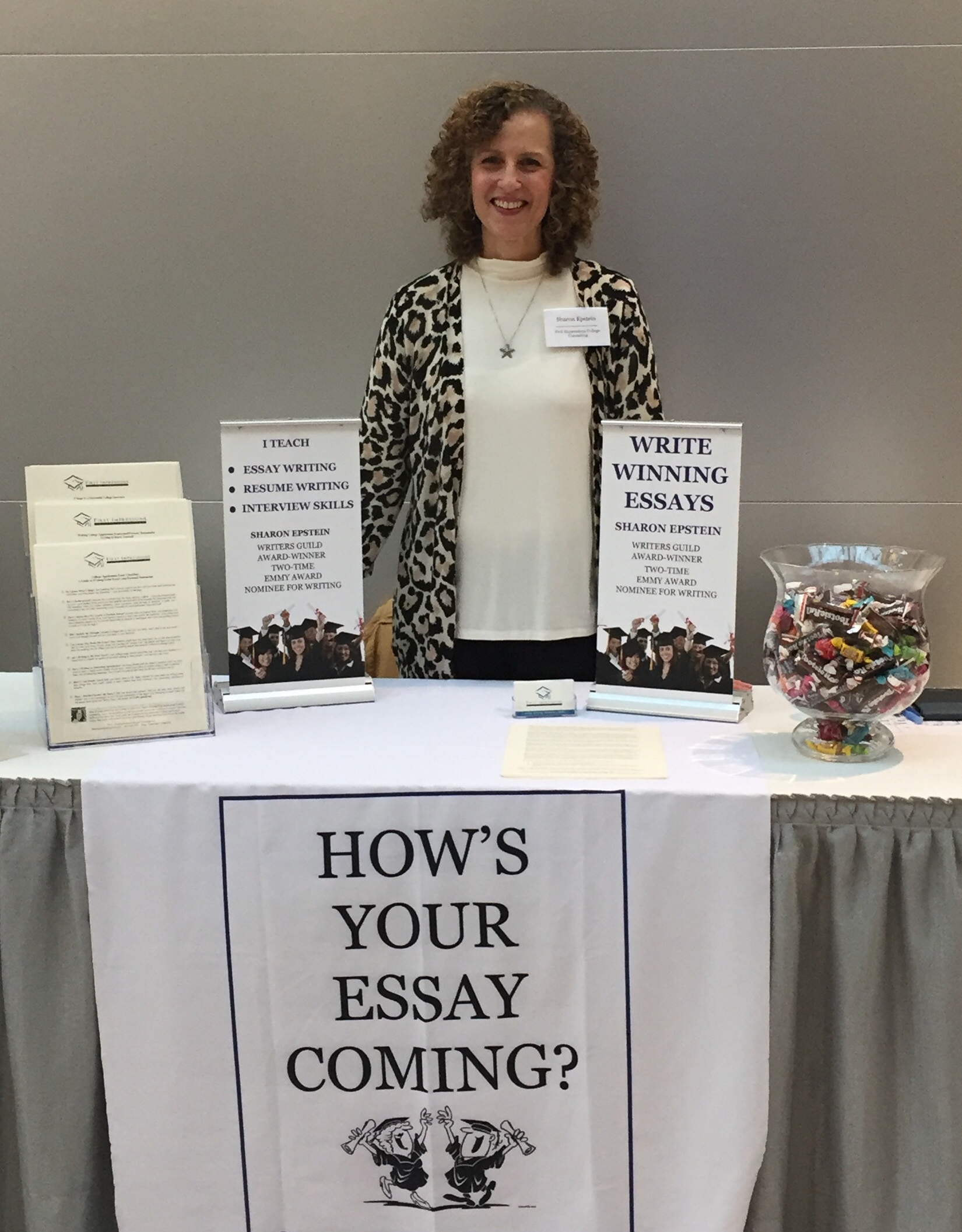 I had lots of fun last night at the Danbury College Fair. Thanks to everyone who stopped by to chat about writing college application essays!

 Sharon Epstein is a Writers Guild Award-winner and two-time Emmy Award nominee, teaching students around the world how to master interview skills, write resumes, and transform their goals, dreams and experiences into memorable college application essays. I work with students everywhere: in-person, by phone, FaceTime, Skype and email. Visit my
 Applying To College